Lust or God
Questioning identity, inherited beliefs, and the fine line between lust and divinity, this piece draws inspiration from the timeless carvings of the Khajuraho Temples—where the human form becomes a bridge between physical existence and spiritual truth.
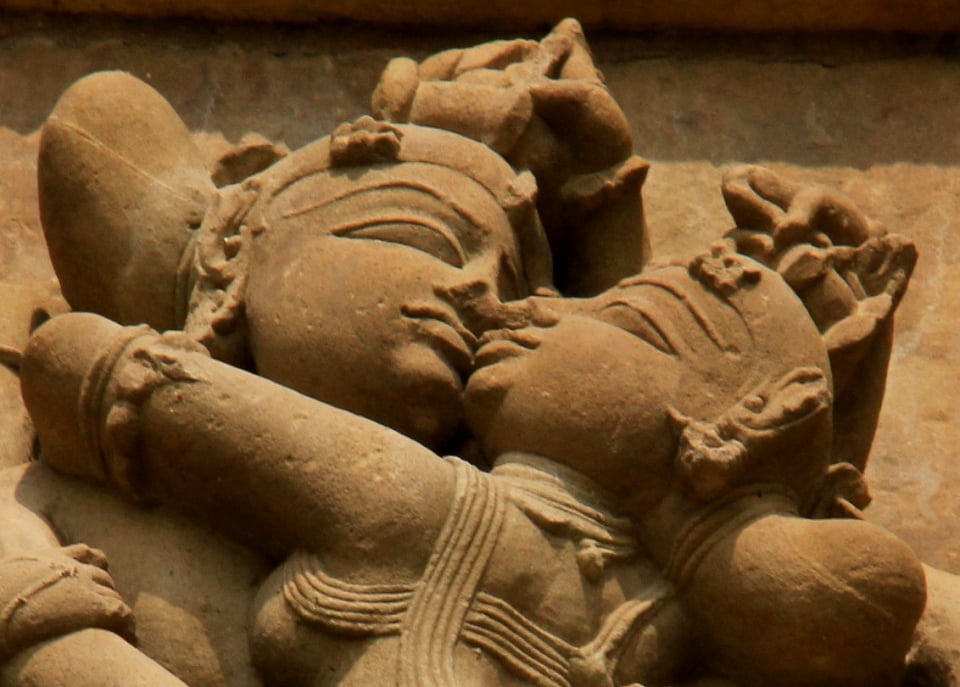
“Do you know who you are?”
No, I won’t answer that, because surely, you are way smarter than me.
But don’t you think even our own name is something given to us by others?
I had this thought once, and then I lost count of what I’ve truly created on my own.
The tales, stories, history, wisdom, traits, everything we carry seems to come from somewhere else. Things we’ve heard, but rarely experienced firsthand. It’s as if we are vessels, carrying inherited information from others rather than discovering it ourselves.
Just like that, I was told the Khajuraho temples have “dirty sculptures”—mostly by people who’ve never even visited them, but simply repeated what they heard from someone else. What is there and what is not doesn’t matter; what matters is that we believe the foretold—without seeing, without discovering.
But by God’s grace, I did witness those masterpieces—carved by unknown artisans (my deepest respect to them). These incredible works were created during the Chandela dynasty, which reached its apogee between 950 and 1050 CE, who ruled the region through the 10th and 11th centuries.
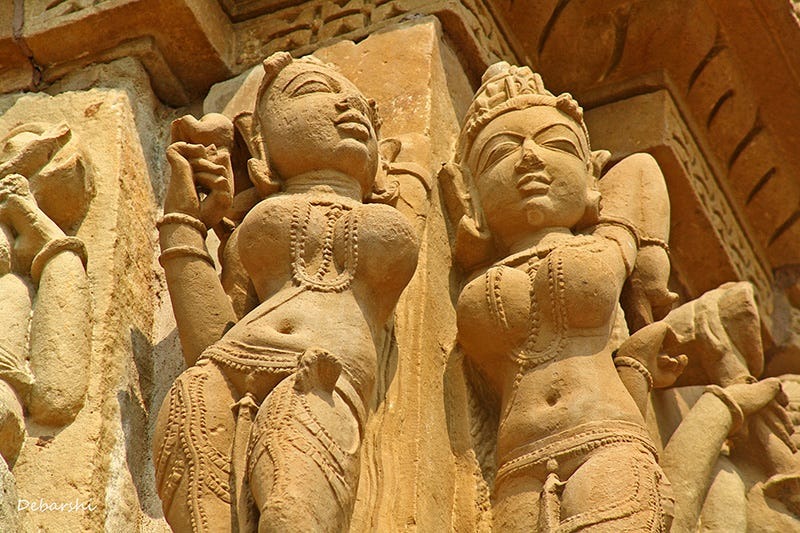
Women have always been muses for art and the sculptures at Khajuraho are living proof of that.
No one can say for certain whether the women of that time truly possessed such graceful beauty, or if some sculptor had a personal muse, much like what is portrayed in Kamasutra cinema.
But what I’m trying to express is this:
These temple structures clearly show that women were always worshipped, and held in the highest regard.
The sculptures speak for themselves. Back in the 11th century, a woman’s body wasn’t seen as an object of Lust, but rather as an embodiment of divine beauty an experience of being, a magnificent creation of God.
There is no vulgarity in these carvings only the blooming of love through the mere existence of the feminine form. And honestly, I would say the same, even if such sculptures were never engraved in stone.
There’s no such thing as taboo, unless you’re hurting someone in the name of religion, or committing any forceful act through manipulation or coercion.
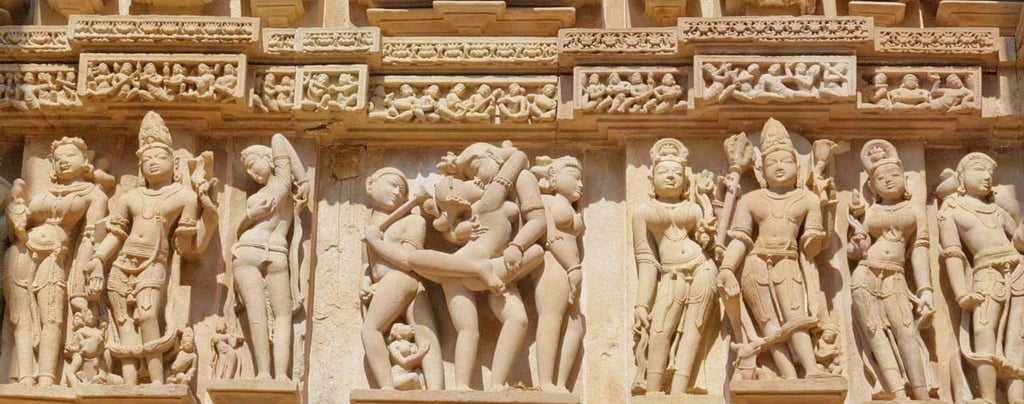
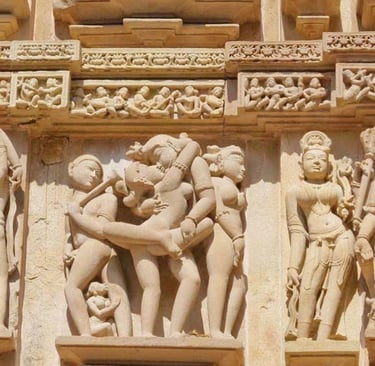
We all come from a sacred energy an endless source of creation.
The sculptures at Khajuraho do not merely portray eroticism; the temples themselves are primarily dedicated to Hindu deities, with most honouring Lord Shiva, Vishnu, and Devi.
Just because something is hard to explain to the masses or to naïve children it is often labeled as taboo or unnecessary. But I once heard that, in ancient times, temples were also centres of education. They held the wisdom of everything meant for generations to learn from, not to ignore or erase.
Sometimes I wonder…
What if time has already destroyed so much more, simply because it feared the generations to come?
What if it feared that we might start questioning the authenticity of our own roots, rather than evolving and adding new value to the books of wisdom?
God never created anything without purpose.
And if I mention Lust oh my dear, you are the very consequence of that sacred energy. Lust is not a sin; it’s a form of divine creation. It’s an art. And when you engage in it consciously, with love, you become a co-creator—you become God himself.
We always have the power to choose where we invest our creative energy:
Whether to remain focused on just the flesh… or to dive deep into our own being and become the God through the path of Lust.