Dancing girl of Mohenjo Daro
What if a sculpture could hold not just form, but emotion? This blog delves into the Dancing Girl of Mohenjo‑Daro—small in size but enormous in symbolic power—honoring how it transcends time as a testament to artistic devotion and human presence.
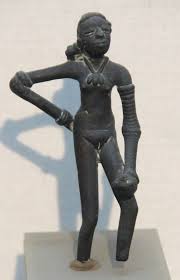
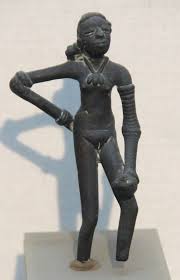
You have to understand this—throughout history, women have often served as muses for an artists. One of the most iconic examples is the Dancing Girl of Mohenjo-Daro, dated to the Harappan Civilization (2700–2100 B.C.E.). This small bronze statuette, measuring just 10.5 x 5 x 2.5 cm (approximately 4 inches in height), depicts a nude young woman with a coiled hairstyle and bangles adorning her arms. She stands with her feet apart and her weight unevenly distributed, suggesting a dynamic posture—perhaps mid-dance.
This strongly suggests that the sculpture may have been created from memory. It feels as though the artist was deeply captivated—perhaps even infatuated—with this woman. So much that he sculpted her form as a mūrti (idol), not merely to represent her, but to preserve her presence. Given the early period in which it was created, the figure may not be anatomically precise, but its emotional and symbolic depth is undeniable.
We cannot ignore the fact that the female body has always been a subject of fascination in art—often depicted in the form of nudes. But here, it seems less about desire and more about devotion. The artist appears to have honored the dancer’s body, not out of lust, but with a deep sense of respect.
And what if the artist was in love with this dancer? Who’s to say! Anything is possible, and the truth remains unknown. But to me, it feels like the artist saw something unforgettable in her—something so moving that he felt compelled to sculpt her. Creations like this don’t arise from obligation; they are born from a profound inner calling.
The girl wears 24 bangles on her left arm and only 4 on her right—possibly decorative, or perhaps symbolic of status or rank. She appears to hold a small vessel in her left hand. Her long hair is tied in a bun at the nape of her neck, and her face is tilted slightly upward, exuding confidence and poise.
Such art is not just a product of skill—it is a product of memory, emotion, and devotion. That’s what makes it eternal.
Do let me know what you think about this !!